
Reviewed · EVENING EXPERIENCES
Porto private night Tour, discover the most iconic attractions
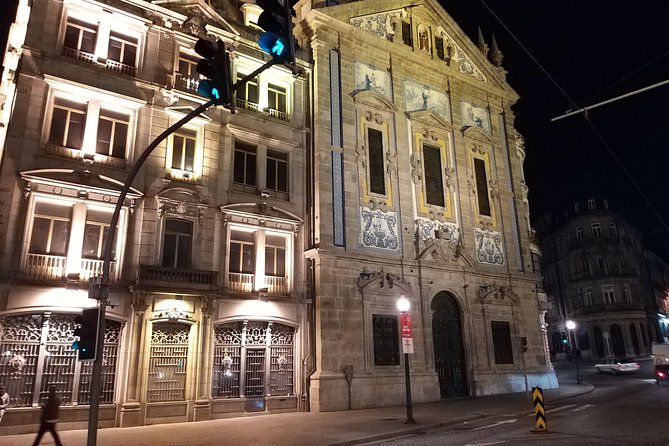
Porto changes character after sunset. The granite churches glow, São Bento Station feels more theatrical, and the Douro bridges become bright outlines above the river. This private night tour gives you a broad view of the city in a comfortable vehicle, with guide Carlos often shaping the route around your interests and stopping for photos.
I like the mix of old Porto and the Atlantic coast, from the Cathedral and Clérigos Tower to Castelo do Queijo and the Foz promenade. I also like the practical comfort: hotel pickup, bottled water, refreshments, and onboard Wi-Fi. The main consideration is time. Three hours is enough for an excellent overview, but not enough to properly visit every church, museum, tower, and cellar listed along the route.
Key points before you book
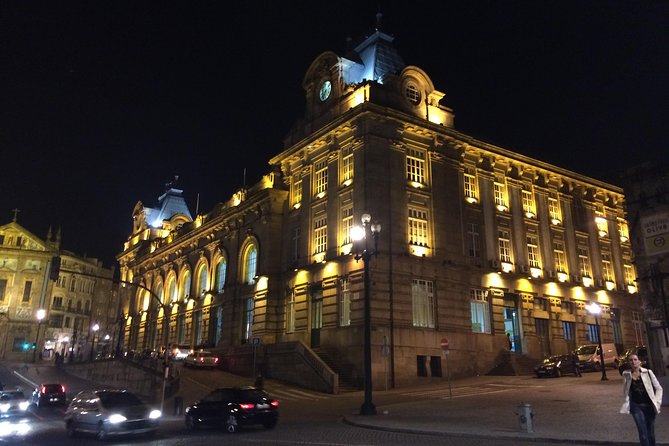
- São Bento Station after dark: See Jorge Colaço’s 20,000 historic tiles in a quieter setting than during the daytime rush.
- A private vehicle and private guide: Your group travels alone, making it easier to ask questions or request photo stops.
- A wide-ranging route: The tour links central Porto, the Douro bridges, Vila Nova de Gaia, the oceanfront, Matosinhos, and Boavista.
- Carlos is a strong guide choice: His tours focus on history, local tips, punctual pickup, and adapting the evening to what you want to see.
- Important ticket detail: Entry to places such as Porto Cathedral, Clérigos Tower, Livraria Lello, São Francisco Church, and Palácio da Bolsa is not included.
- Optional evening add-ons: You can add a one-hour Fado show with Port wine or a 90-minute Port cellar visit, but the tour starts two hours earlier.
What this three-hour Porto tour really offers
At $184.84 per person, this is not a budget sightseeing ride. Its value depends on your group size and priorities. If you are traveling with family or friends, the private format can make the price more reasonable than booking several separate taxis, especially since transport, a guide, hotel pickup, Wi-Fi, water, and refreshments are included.
The route is ambitious. It includes central landmarks, bridges, viewpoints, coastal forts, Matosinhos, Serralves, Casa da Música, and the Peninsular War monument. In practice, you should think of it as a panoramic introduction with selected short stops, not a three-hour museum tour.
The listed stop times add up to far more than three hours if every site is entered. Some locations are photo stops or exterior explanations. That is not a flaw, but you should tell your guide which places matter most. Carlos has been praised for asking what you want to see, making photo stops, and offering useful advice for the rest of your stay.
The tour is offered in English. It begins at Praça da Liberdade 19, though pickup is available from downtown Porto and Gaia hotels and bed-and-breakfasts. It returns to the meeting point.
More evenings out in Porto:
- Porto: Bridges Cruise with Wine Cellar Tour or Sunset Option
★ 4.1 · 2,758 reviews - Porto: Douro River Party Boat with Sunset Option & 6 Bridges
★ 4.7 · 2,040 reviews - Porto: Charming Sailboat Cruise with Port Wine,Sunset Option
★ 5.0 · 1,978 reviews
Praça da Liberdade, Aliados, and Porto’s central face
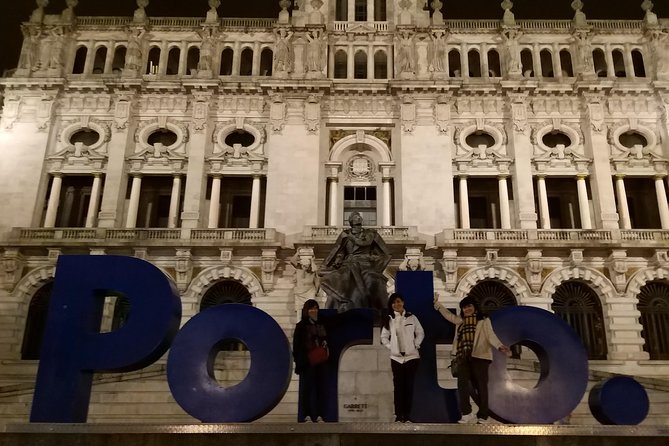
The evening usually begins around Porto’s grand civic center. Avenida dos Aliados is a broad avenue lined with buildings from the 1920s and 1940s, ending near Porto City Hall to the north and the Cardosas building to the south.
In the adjoining Praça de D. Pedro, you will see the statue of D. Pedro IV, known as the Liberator. This is a useful place to begin because Porto’s central monuments sit close together, yet the city’s steep streets and layered architecture can make orientation difficult on foot.
Nearby Praça da Batalha adds more context. Its name reaches back to a medieval defeat involving the forces of Almançor, after which Porto was destroyed. The square later became an important urban space, and it is home to Teatro São João, first opened in 1798 and rebuilt after a major fire in 1908.
You may also pass the Rivoli Theatre, a former cinema and performance venue near D. João I Square. These stops help explain Porto as a working cultural city, not simply a collection of old façades.
Bolhão Market and the city’s everyday life
Mercado do Bolhão is Porto’s best-known market. Its neoclassical structure dates from the 19th century and is arranged around four streets: Fernandes Tomás, Alexandre Braga, Formosa, and Sá da Bandeira.
The market is devoted mainly to fresh food, with sections for fish, meat, vegetables, and flowers. The listed visit is brief and free, so you should not expect a long shopping stop at night. Still, even an exterior look helps place Porto’s food culture within the city center.
This is one of the useful contrasts in the tour. Grand churches and monuments tell one story, while Bolhão shows the practical side of Porto. If your evening departure is late enough for the market to be active, ask Carlos how much time is available. Opening conditions are not specified, so do not book this tour solely for an indoor market visit.
São Bento Station, the Cathedral, and tiled Porto
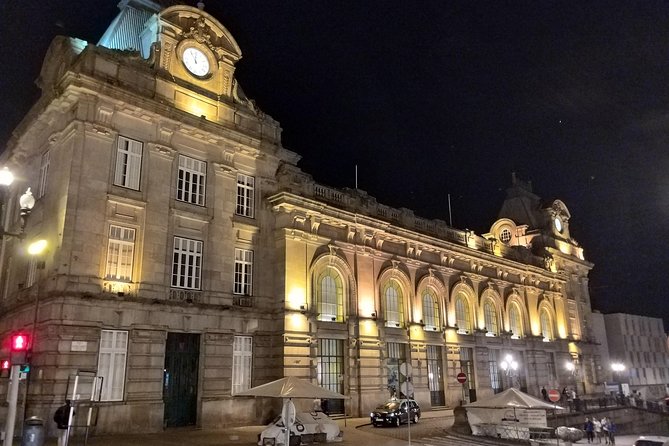
São Bento Railway Station is one of the evening’s best stops. The station occupies the site of the former Convent of São Bento de Avé Maria, and its early 20th-century iron and glass structure was designed by Marques da Silva.
The main vestibule is decorated with about 20,000 painted tiles by Jorge Colaço. They show scenes from Portuguese history, transport, and regional life. You can take in a surprising amount in 15 minutes, especially if your guide explains what to look for rather than simply pointing at the walls.
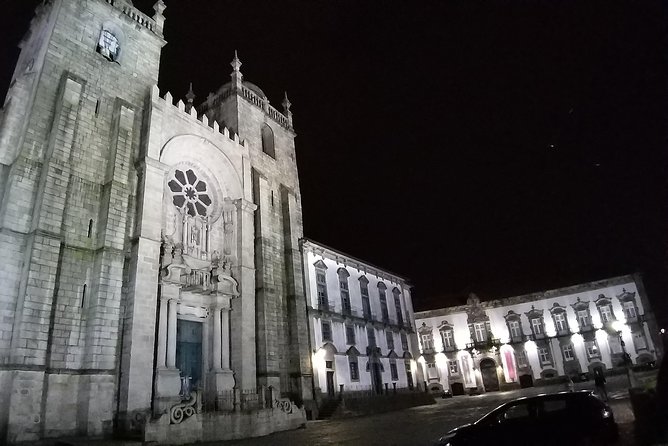
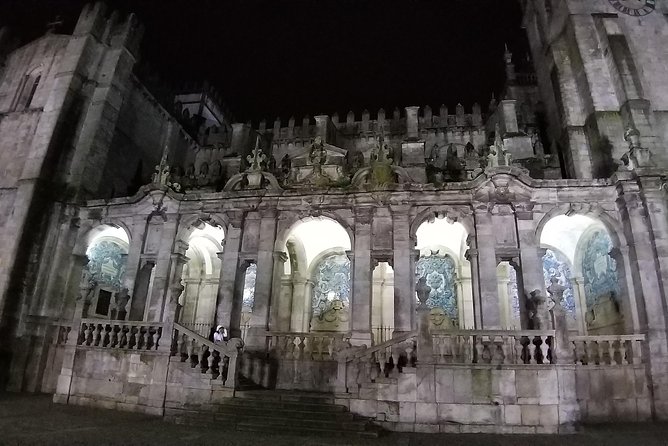
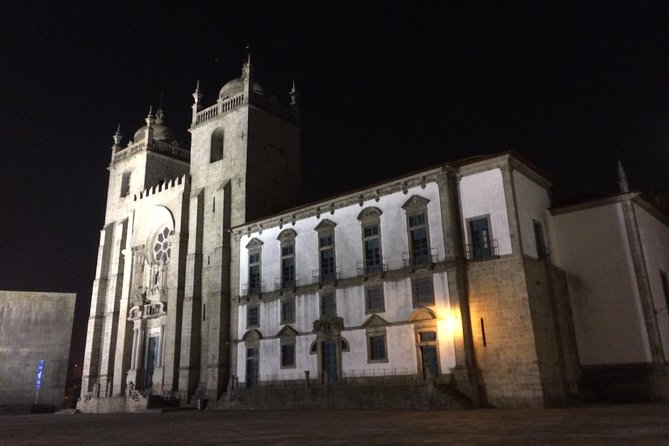
Porto Cathedral is older and more severe. Its original building dates from the 12th and 13th centuries, though it was altered across later periods. The Gothic Chapel of St. John the Evangelist, the cloister, the expanded chancel, and the silver altar in the Chapel of the Blessed Sacrament are the key details.
Entry to the cathedral is not included. The schedule gives about 15 minutes, which is enough for a quick visit if the cathedral is open and you pay admission, but not enough for a slow look at every feature. Confirm your priorities with the guide before arrival.
The nearby remains of the Fernandina Wall offer another quick history lesson. Built to handle Porto’s growth, the wall was nearly complete around 1370 and finished under King Fernando in 1409. Much of it was later demolished, leaving only scattered sections.
More private Porto tours:
- Discover Porto’s Highlights on a 2-Hour Private Electric Tuk Tuk
★ 4.5 · 1,860 reviews - Porto PRIVATE TOUR With Locals: Highlights & Hidden Gems
★ 5.0 · 984 reviews - Porto: Private tour in the Douro (1 to 4 people) on a boat just for you
★ 5.0 · 744 reviews - Historic Porto by Private Electric Tuk Tuk to Top Landmarks
★ 4.5 · 735 reviews
Clérigos, Livraria Lello, and the churches of Carmo
The Clérigos Tower is one of Porto’s signature landmarks. Nicolau Nasoni designed the Baroque tower in the 18th century, and the top is reached by 240 steps. The view over Porto and the Douro is excellent, but the admission fee is not included and a night visit depends on opening hours.
The tour allows roughly 10 minutes here, so you are more likely to see the tower and hear its story than climb it. If the panorama is a priority, ask whether the schedule allows enough time.
Livraria Lello is another famous stop. Opened in 1906, the bookshop has an Art Nouveau façade with Neo-Gothic details, a dramatic staircase, and a stained-glass skylight marked with the library’s monogram and motto.
The tour does not include admission. Five minutes is a short exterior or orientation stop, not a full bookstore visit. If you want to go inside, treat the ticket and time as a separate part of your plan.
I especially like the Carmo and Carmelitas area because it rewards close looking. The two Baroque churches face one another, and a narrow house is squeezed between them. The Carmo Church is known for its painted exterior tiles, while the adjoining church has its own ornate façade. This small architectural gap says a lot about how Porto was built in tight spaces.
São Francisco, Palácio da Bolsa, and the Douro riverfront
São Francisco Church is one of the most dramatic interiors in Porto. Its Gothic construction began in the 14th century, but the interior was later covered with elaborate gilded woodwork. The Tree of Jesse and the catacombs deserve attention if you enter.
The church is a National Monument and part of Porto’s UNESCO-listed historic center. Admission is not included, and the planned five-minute stop suggests a quick introduction rather than a full visit.
Palácio da Bolsa is another major building near the river. Designed in a neoclassical style in the 19th century, it occupies the site of a former Franciscan convent destroyed during the Siege of Porto. Its Arab Room is the best-known interior.
Again, admission is extra. Five minutes allows you to see the exterior and hear why the building matters. If you want to tour the inside, the private format helps because you can discuss replacing another stop, but the standard route will not provide a full guided visit.
The riverfront section also introduces Porto’s bridge story. You may see the remains of the old suspension bridge, the lower and upper levels of Dom Luís I Bridge, the newer Infante Bridge, and the older railway bridges.
The bridges and Gaia viewpoints after sunset
Dom Luís I Bridge is the great visual anchor of Porto. Its wrought-iron arch was inaugurated in stages in the 1880s, and its upper deck now carries a Porto Metro line. The bridge and historic center form part of the UNESCO World Heritage area.
Ponte D. Maria Pia, designed by Gustave Eiffel with Théophile Seyrig, was completed in 1877. It carried trains for 114 years before São João Bridge took over its railway role. The bridge is no longer used for regular rail service, but its arch remains an important part of the river view.
Across the water, Jardim do Morro provides a wide view toward Porto. It is a public garden with paths, greenery, and a particularly useful angle on the upper deck of Dom Luís I Bridge. The nearby Monastery of Serra do Pilar has an unusual circular church and cloister. It began in 1538 and is also part of the UNESCO-listed area.
These are among the strongest night stops because you can understand Porto’s shape quickly. The lights along the river, the bridge structure, and the hills on both sides make the city easier to grasp than it may be from street level.
From the river to the Atlantic coast
The route then moves west, giving you a very different Porto. The Arrábida Bridge, completed in 1963, was once the longest reinforced-concrete bridge of its kind. Its four pillars carry bronze sculptures, adding a decorative touch to a very functional structure.
Fort São João Baptista guarded the Douro entrance and coast. It began as a late 16th-century fort and gained additional defenses in the 17th century. Admission is not included, and the 10-minute stop is best viewed as an exterior visit.
Castelo do Queijo, officially Fort São Francisco Xavier, sits on a rocky rise by the Atlantic. Built in the 17th century to help protect the coast from North African pirates, it takes its popular name from the cheese-like shape of the rock.
The oceanfront portion can be a welcome change after the dense center. You may also pass the equestrian statue of D. João VI, the large Anemone sculpture by Janet Echelman, and Leixões Port, which handles cruise ships and has a dedicated cruise pier.
The Anemone is especially easy to remember. Made from a large fishing net, it moves with the wind and resembles a sea creature above the roundabout. This is the kind of modern detail that a standard old-town tour might miss.
Serralves, Casa da Música, and Boavista
The route can include the Serralves Foundation, with its Art Deco house, contemporary art museum, and 18 hectares of gardens, farmland, and woodland. The visit is not listed as an extended indoor stop, so expect an exterior explanation unless you arrange otherwise.
Casa da Música is Porto’s bold contemporary concert hall. Designed by Rem Koolhaas and opened in 2005, its angular form is a sharp contrast to the granite churches and tiled façades of the historic center.
Nearby Praça de Mouzinho de Albuquerque is dominated by a 45-meter monument to the Heroes of the Peninsular War. Its sculptures represent the Portuguese and English alliance and the defeat of Napoleon’s French forces.
This final part of the route gives the city a wider frame. Porto is not only medieval lanes and Baroque interiors. It also has modern architecture, public art, concert halls, ports, beaches, and large civic spaces.
Optional Fado and Port wine additions
You can add a one-hour Fado performance with Port wine for €20 to €26 per person. The show runs daily at 18:00 and 19:30, and the tour starts two hours earlier when this option is booked.
A Port cellar experience is also available for €32 to €41 per person. It lasts 90 minutes and includes a tasting of five Port wines, along with the story of Dona Antónia Adelaide Ferreira and her role in the Douro wine trade. This also moves the tour start two hours earlier.
These options can make the evening more complete, but they change the shape of the experience. If you choose one, expect less flexibility for the long sightseeing route. You can also request a two-hour extension for €60 per booking.
Comfort, timing, and practical details
The vehicle is described as a luxury vehicle with Wi-Fi, bottled water, refreshments, and extra equipment suited to your needs. That matters on a route covering central Porto, Gaia, the river, the coast, and Boavista. You will spend less time managing transport and more time listening or looking out the window.
The tour is private, so only your group participates. This is useful if someone needs a slower pace, if you want more photo stops, or if you want to focus on churches rather than the coast. It also gives you a chance to ask Carlos for restaurant, sightseeing, and routing advice.
The experience requires good weather. If poor weather cancels it, you can choose another date or receive a full refund. Otherwise, cancellation is free up to 24 hours before the start time, with no refund for later cancellation.
Should you book this Porto night tour?
Book it if you want a comfortable first look at Porto after dark, especially if you are staying in the city for a short time, traveling with family, or prefer not to tackle steep streets and scattered sights alone. The private vehicle, hotel pickup, English-speaking guide, and broad route offer real convenience.
Choose it with realistic expectations. You will not thoroughly tour every listed monument in three hours, and several admission fees are extra. For the best experience, decide in advance which three or four places matter most, then let the guide build the evening around them.
Carlos is the guide to request if available. His approach combines history with practical local advice, and he has shown a willingness to adapt for photo stops, special interests, and rainy conditions. For a wide city overview with strong river and ocean views, this is a useful and personal introduction to Porto.
FAQ
How long is the Porto private night tour?
The tour lasts approximately three hours.
Is hotel pickup available?
Yes. Pickup is offered from downtown Porto and Gaia hotels and bed-and-breakfasts. The listed meeting point is Praça da Liberdade 19 in Porto.
Is this a private tour?
Yes. Only your group participates in the activity.
What is included in the tour?
Transport in a luxury vehicle, onboard Wi-Fi, bottled water, refreshments, and personal accident and liability insurance are included.
Are entrance tickets included?
No. Admission is not included for several sites, including Porto Cathedral, Clérigos Tower, Livraria Lello, São Francisco Church, Palácio da Bolsa, the Fortress of São João Baptista, and Castelo do Queijo.
Can I add Fado or a Port wine cellar visit?
Yes. A one-hour Fado show with Port wine costs €20 to €26 per person, while the 90-minute Port cellar tour costs €32 to €41 per person. Either option makes the tour start two hours earlier.
Newest Porto reviews on the site
- Porto – Old Town Tour with an official guide★ 5.0 · 6 reviews
- Yacht Douro Tour★ 4.8 · 11 reviews
- Vila Nova de Gaia: Porto Discovery Tasting★ 4.8 · 17 reviews
- Visit to a Port Wine Cellar★ 4.8 · 5 reviews
- Vila Nova de Gaia: Winery Tour with 2 DOC Douro & 1 Port★ 4.8 · 101 reviews
- Vila Nova de Gaia: Douro Discovery★ 5.0 · 4 reviews
- WOW Porto: The Wine School Workshops and Tastings★ 4.7 · 20 reviews
- Private Portuguese Cooking and Wine Experience in Porto★ 5.0 · 30 reviews
Evening Experiences, compared.
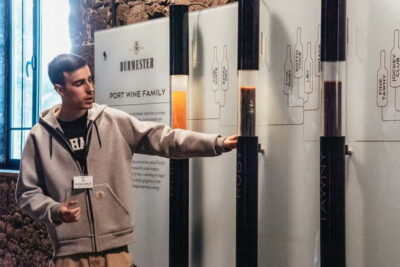
Bridges Cruise with Wine Cellar Tour or Sunset Option
Read our review →
Douro River Party Boat with Sunset Option & 6 Bridges
Read our review →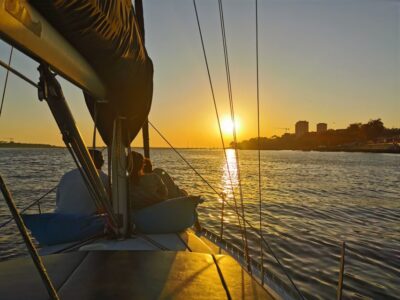
Charming Sailboat Cruise with Port Wine,Sunset Option
Read our review →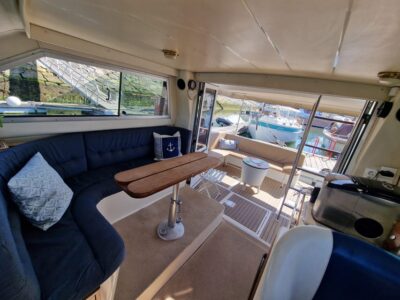
6 Bridges Cruise & Port Wine with Sunset Option
Read our review →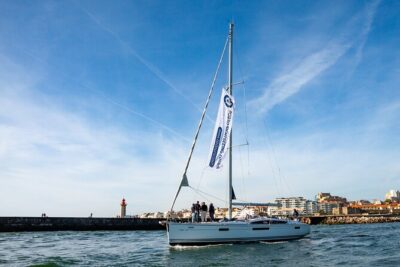
Porto Douro River Cruise With Port Wine – Daytime or Sunset
Read our review →
Daytime or Sunset Douro River Sightseeing Cruise
Read our review →
Port : 6 Bridges Cruise , Douro River with Sunset Option
Read our review →Browse the lists this tour appears in